Sales, orders, returns, inventory, performance and reports.
The Analytics section is six pages, each built the same way — a date picker, KPI cards,
charts, and breakdown tabs — each answering one question. Which pages your plan includes is
graded; see Date ranges & plan history
for the other half of what plans change here.
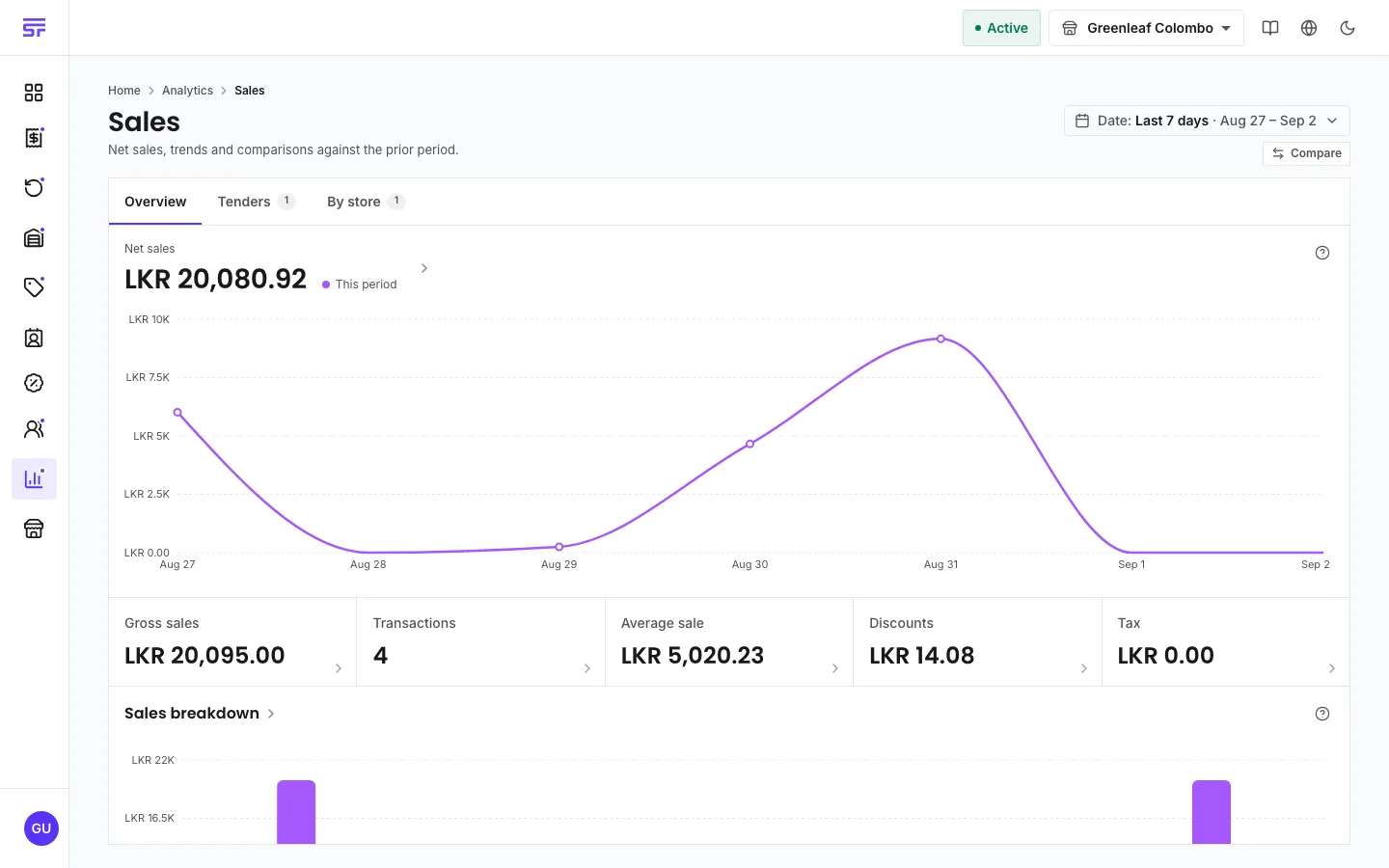
Sales — what did we take? Net and gross sales, transactions, average sale,
discounts and tax; a Tenders tab splitting takings by payment method; a By store
tab with each store in its own currency.
Orders — how were we ordered? Counted by the date each order was placed, any
status, with breakdowns by payment method, fulfilment type and channel (money facets count
completed orders only), and a Cancellations tab with the rate.
Returns — what came back, and why? Breakdown-led: reasons, dispositions (counted
per item, not per return), refund methods, products.
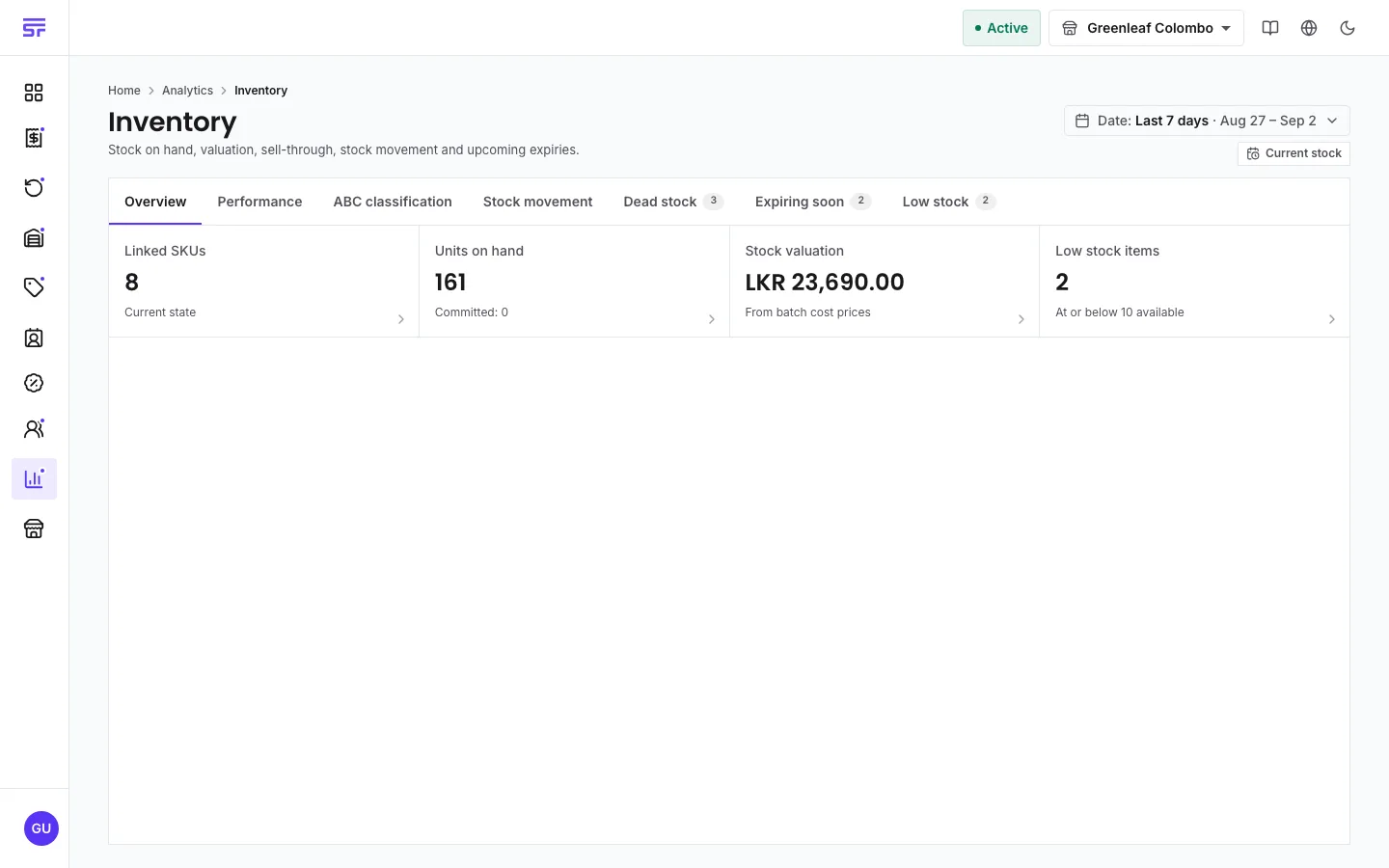
Inventory — what is our stock worth, and how is it moving? Mixes snapshot cards
(units on hand, valuation from batch cost prices, low stock) with windowed ones
(units sold, sell-through, shrinkage from the coded stock ledger, ABC grades).
Performance — who and what performed? Rankings by store, product, category and
customer; a row opens that entity's own report. Guest checkouts fold into one "Guest" row.
Reports — the printable registers. X (today so far) and Z (a closed day) register
reports in till-roll formats, a sales summary and current stock on hand.
The Tenders tab, the Orders page's payment-method breakdown and the register reports all
answer the same question, and they answer it the same way:
Completed orders only. An open order's payments are not takings yet.
A split payment counts once per method, with the amount each method actually carried —
an order paid part cash, part card appears under both, and the amounts add up to the
completed total. Read the transaction count as payments, not sales, when customers often
split.
What was undone before the sale closed is already taken off: a voided payment or a
refunded overpayment never reaches the figure.
The register reports add one more rule. Tenders are gross: a refund paid out of the drawer
is not deducted from them. Refunds paid out is its own block beside them, counted on the
day each refund was completed and grouped by how it was paid back. The two are different
days' events — a refund against last week's sale reduces today's drawer, not today's takings —
so reconcile the drawer as tenders in, refunds paid out.
Snapshot cards wear a 'Current stock' chip — the date picker doesn't touch them.
Where a number has an honest caveat, the page prints it rather than hiding it: "Only
completed orders count towards money…", "A product listed in multiple categories counts
fully under each…", "Checkouts made without a customer record are grouped as one row."
Read the small print under a surprising figure first — the explanation is usually already
there, and the full catalogue is Metric definitions.