
Discount types
Percentage, fixed amount, buy-X-get-Y and volume discounts, with worked examples.
Available on Startup and above
User guide
Percentage, fixed amount, buy-X-get-Y and volume discounts, with worked examples.
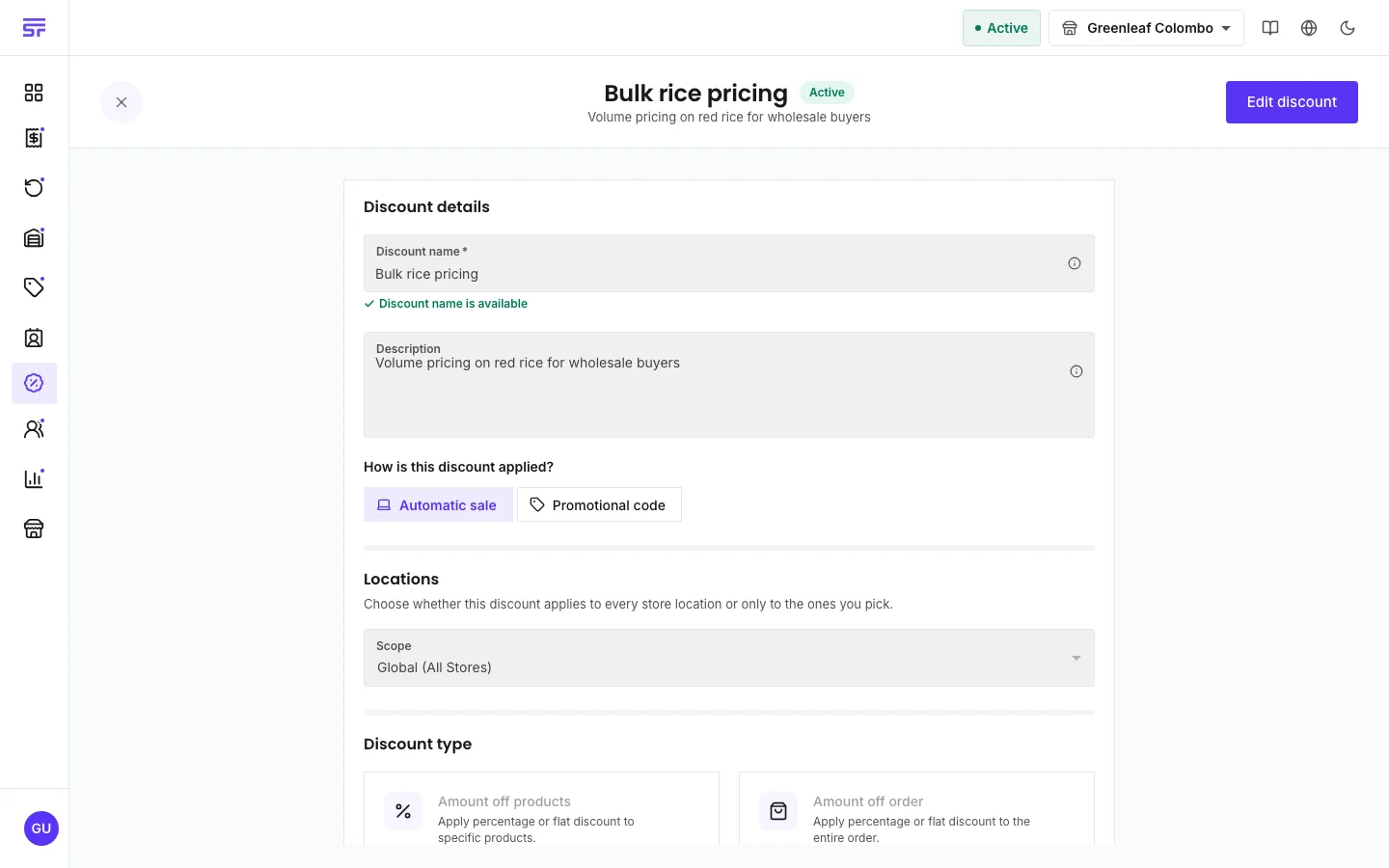
The builder offers four discount types. The examples below use round numbers; the engine works the same way at any scale.
A percentage or fixed amount off specific products or categories. The eligible lines are summed, the discount computed on that sum, and the result spread across those lines.
20% off T-shirts. Cart: two $25 shirts and $40 jeans → eligible subtotal $50 → $10 off, split across the shirt lines. The jeans are untouched.
A percentage or fixed amount off the whole cart. One subtlety that matters when discounts stack: an order discount computes on what the lines are worth after product discounts already took their share.
$100 cart. A 20% product discount takes $20 first; a stacking 10% order discount then takes 10% of the remaining $80 = $8 — not $10.
Buy a qualifying quantity, get target items free or reduced. Two rules to know:
Buy 2 get 1 free on $2 sodas. Six sodas → the deal applies twice → $4 off. At "50% off the third" instead of free: $2 off.
Per-line quantity breaks: the tier containing the line's quantity applies — a percentage, a fixed amount, or a flat unit price the line is reset to.
Tier "5–9 → $8 flat price" on a $10 item: a line of 6 pays 6 × $8 → $12 off. Tier "10+ → 15%": a line of 12 → $18 off.
A manual discount at checkout — percentage or amount, with a reason that prints on the receipt — is applied last, on top of whatever the catalogue discounts left. It is an on-the-spot decision, not a record, so no limits or schedules apply to it.
How discounts work · Rules & scheduling · Combining discounts